
Manjusha Nair speaks to Charles Daniel McDonald about her work with Alef Trust’s Conscious Community Initiative, Participatory Media Images of Change, exploring how transpersonal approaches can reshape education and nurture young people beyond conventional learning models.
In Tamil Nadu, a new museum is being built to honour the history of Hansen’s disease, more widely known as leprosy. For seventy years, a pioneering hospital has been at the forefront of treating the condition, offering not only medical innovation, but also dignity to patients who might otherwise have been ostracised. Figures such as Dr. Paul Brand and Margaret Brand developed groundbreaking reconstructive surgery for eyes, hands, and feet – parts of the body most affected by the disease. Alongside medical work, missionaries and doctors help to create a rare space of inclusion in a village where stigma once prevailed.
The museum will preserve this remarkable legacy. It recognises not only the advances in treatment and early detection that have transformed lives, but also the social and psychological battles that patients endured. “This hospital was a light of hope for people who would otherwise have been cast aside,” explains Manjusha, who is part of the team. “The museum is our way of remembering both the suffering and the progress achieved.”
While this curatorial work has taken centre stage in recent months, her attention often returns to another, equally ambitious project: transforming education in India through transpersonal approaches to learning.
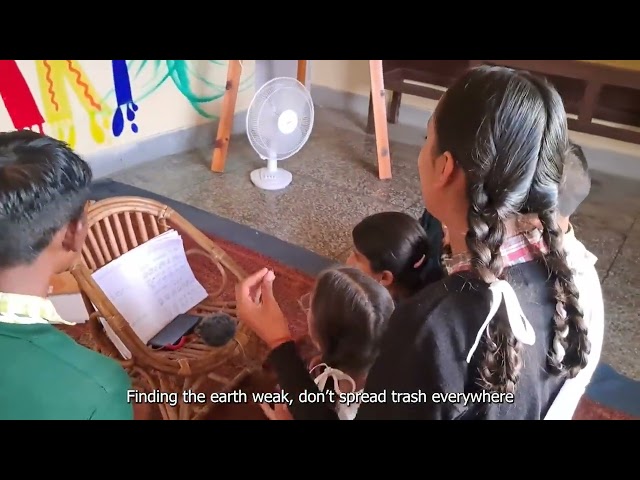
For two years, she has led a programme in Himachal Pradesh, blending pedagogy with meditation, contemplation, and creative expression. The aim has been to nurture confidence, curiosity, and ethical awareness in children. The results were striking. Students who began hesitant and withdrawn grew into confident leaders, producing short films and presenting their work to local schools. The project’s academic mentor Dr. Joan Walton was struck by the transformation. “It was exhilarating to see them take charge,” she recalls.

The foundation of this success lies in reimagining the classroom. Rows of desks and passive note taking were replaced with a circle, creating a safe space for dialogue, reflection and listening. Breathing practices and shared silence grounded the group, while trust building allowed genuine peer learning. Older and younger students collaborated, overcoming assumptions about age and ability. Projects on ecology, rivers and local environments became multi layered explorations, incorporating history, science, geography, and art. Learning was experiential, contextual and alive.
Creativity, in this context, extended beyond art to a way of engaging with the world. “It’s about openness,” Manjusha explains, “the willingness to question, to explore, and to admit when you don’t yet know.” By weaving together ecology with spirituality, science with art, and psychology with philosophy, the project revealed the power of transpersonal education. Ethics and compassion were central, ensuring that knowledge was not just intellectual but socially grounded.
Yet, India’s wider education system still remains rigid. A strong emphasis on science, technology, engineering, and medicine sidelines the arts and humanities. and policies are standardised across states – leaving little scope for innovation. While some schools experiment with “happiness projects”, these often remain superficial. Breaking into the formal system is formidable, but Manjusha remains determined. Discussions are already underway with Universities keen to embed her approach within art and design courses, and with teacher training organisations that could spread the model more widely.

The stakes are high. India is now ranked among the world’s largest economies, yet rapid growth has a cost. “What message are we sending to our young,” she asks, “if we treat them only as an economic resource? If knowledge is reduced to financial security, we limit their potential and our collective future.” She believes the arts can restore balance by encouraging reflection, creativity, and ethical choice making, qualities vital to society as well as to individuals.
This perspective is not alien to India. The Upanishads contain ancient poetic explorations of consciousness and the self. But in the rush for global power, such wisdom risks being forgotten. “Our task is to remember,” she says, “to bring these values back into education, so that learning is not just about skills but about becoming whole.”
For Manjusha, the path forward lies in perseverance: working with teacher training organisations, entering universities, and slowly opening doors in schools. It is a long journey, but one she sees as essential. “If we can create spaces of safety, connection and creativity in education, we give our young not only the tools to succeed, but the grounding to thrive as human beings.”
Discover more about Alef Trust´s Conscious Community Initiative projects, here.




No Comments